Best accounting software for startups in 2026
Best accounting software for startups in 2026: ten tools with prices read on 9 November 2026, free plans, what 3 users pay a year and who should skip each.
 Ruslan NazarovHead of SAASLEDGE
Jump to
- Best accounting software for startups in numbers
- What a startup needs from its books
- The best accounting software for startups, one by one
- What accounting software costs a startup over a year
- Free accounting software for startups: what free allows
- AI accounting software for startups: what to check
- Early stage SaaS startup accounting software
- Limits that decide fit
- Software, bookkeeper or both
- How to trial and move in without losing a month
- Compare
- FAQ
The best accounting software for startups is the one that still fits when the team grows from one founder to five and the first investor asks for a monthly close. Ten tools are compared below, with prices read on the vendors’ own pages on 9 November 2026. They sit in the finance and accounting shelf of the catalogue.
Three of the ten have a permanent free plan, two are built around AI-drafted books, and one, Pilot, sells the bookkeeping itself. The rest differ mostly in what they charge for the second user and the second hundred invoices.
Best accounting software for startups in numbers
Eight figures say more than a ranking would. Each one names the vendor and the day it was read.
- $0 a month is the Zoho Books free plan, for 1 user and 1 accountant, and it stays free while revenue for the financial year stays under $50K, read 9 November 2026
- $19 a month or $190 a year is Wave Pro, against $0 for Wave Starter, read 9 November 2026
- $10, $27, $59 and $97 a month are the four Xero plans in the US, with no per-user license fees, read 9 November 2026
- $22 and $30 a month are the single plans of FreeAgent and Kashoo, which offer a 30-day and a 14-day trial instead of a free plan, read 9 November 2026
- $38 a month is the list price of QuickBooks Online Simple Start for 1 user, shown at $19 for the first 3 months, read 9 November 2026
- $23 a month is FreshBooks Lite for 5 billable clients, and Plus at $43 raises the limit to 50, read 9 November 2026
- $30, $65 and $99 a month are the entry plans of Puzzle, Digits and Pilot, the three products built around AI or done-for-you books, read 9 November 2026
- $1,020 against $180 a year is what 3 users pay on QuickBooks Essentials and on Zoho Books Standard billed annually, at list price
The two plans that list three users on their pages differ by a factor of almost six, and neither bill includes payroll.
What a startup needs from its books
A startup needs its accounting software to answer four questions without a spreadsheet. How much cash is left? Where did the money go? Who owes us? Can an outsider read the numbers? Everything else is a bonus until the first hire. Easy accounting software for startups still has to give an investor a readable profit and loss.
That gives four tests. Bank and card feeds should match transactions to receipts instead of asking for retyping. The reports should include a profit and loss and a balance sheet that an investor or lender will accept. The pricing should not jump when a second or third person needs access. The data should leave in a format your next accountant can open.

Accounting software for startups also has to fit the people around it. A part-time bookkeeper or an outside accountant needs access, and some plans cap or price that access. For a wider view of how this sits with the rest of the stack, our guide to software for small business covers the other shelves.
The best accounting software for startups, one by one
Each entry gives who it suits and what it does better than the rest. Then come its limits, as real Pros and Cons, and who should skip it.
Order follows the cost of getting started: the three products with a permanent free plan come first, then the paid-only products from the lowest entry price to the highest.
It is not a ranking, and nothing on SAASLEDGE is ranked for money. Whether you search for the top accounting software for startups or the most reliable accounting software for startups, the first pick depends on your situation, not on a league table.
Every figure is the list price read on 9 November 2026, and any promotion is named separately. The list leaves out products with no published price, and the rules for what the catalogue counts apply here as everywhere on the site.
Wave
Wave suits a solo founder who invoices clients and wants books at no cost. Wave Starter is $0 and creates unlimited estimates and invoices. Bills and bookkeeping records come with it, as does a mobile app.
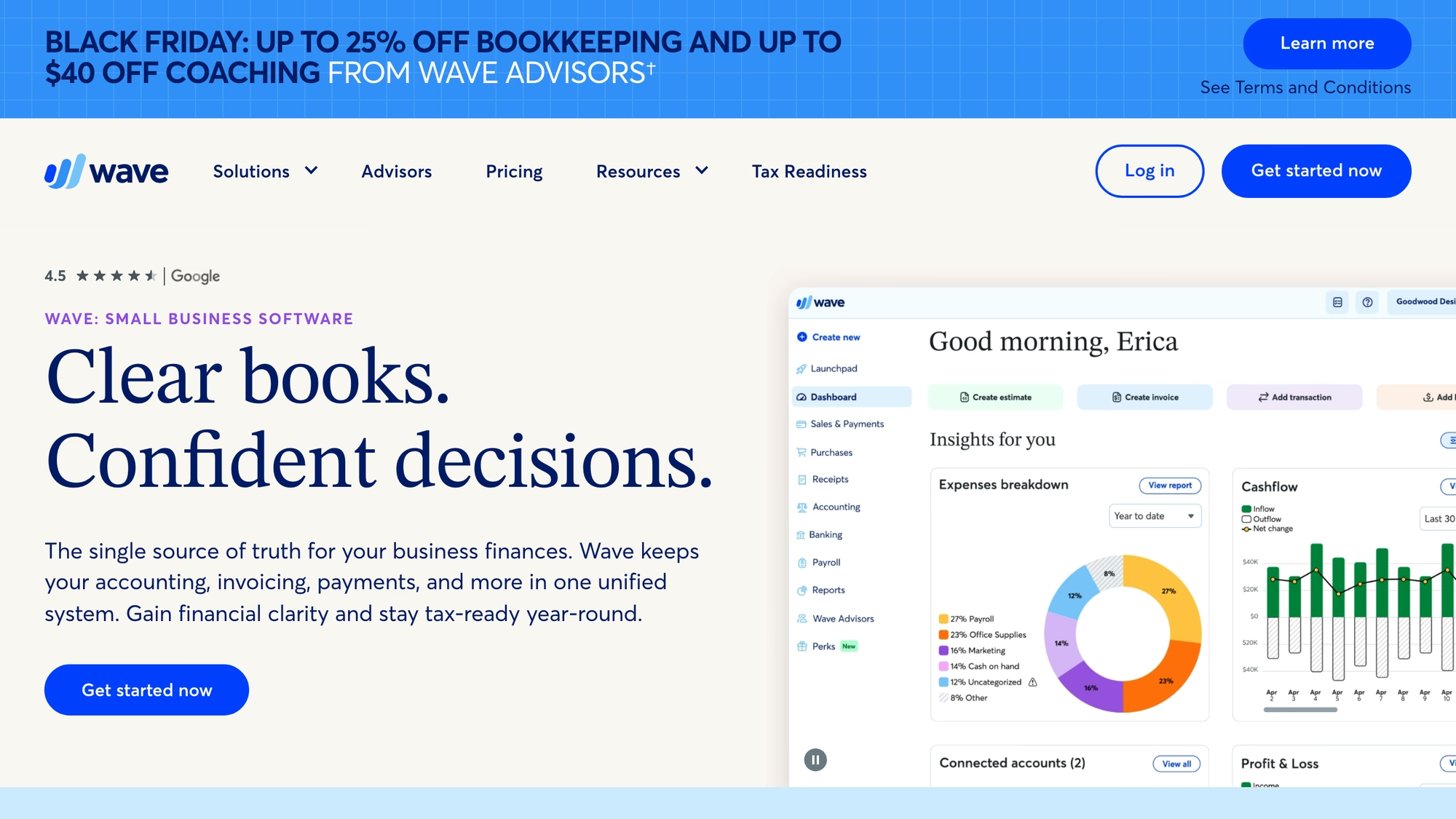
Starter charges 2.9% plus $0.60 per credit card payment, and Wave Pro is $19 a month billed monthly or $190 a year, with 2.9% and no fixed fee per card payment. Wave also sells Wave Advisors, a done-for-you bookkeeping service starting at $149 a month on the same page, which is a different product from the software.
Pros
- Starter is $0 with unlimited estimates, invoices, bills and bookkeeping records
- Pro adds automatic bank transaction import with categorisation, and unlimited receipt capture
- Card payments on Pro carry no fixed fee, against $0.60 per payment on Starter
Cons
- Bank import is a Pro feature, so the free plan means typing or uploading transactions
- Wave notes that bank connections run through Plaid and that not every institution is supported, so check yours before relying on it
- The page lists admin, editor and viewer roles under Pro, and only a payroll manager or a tax pro on the free plan
Skip it if you need several users with different roles, or if investors will want accrual reports from a ledger built for freelancers.
Zoho Books
Zoho Books suits a pre-revenue or early-revenue team that wants real accounting for nothing. The Zoho Books pricing page lists a free plan for 1 user and 1 accountant, and says it is available indefinitely while revenue for the financial year stays under $50K.
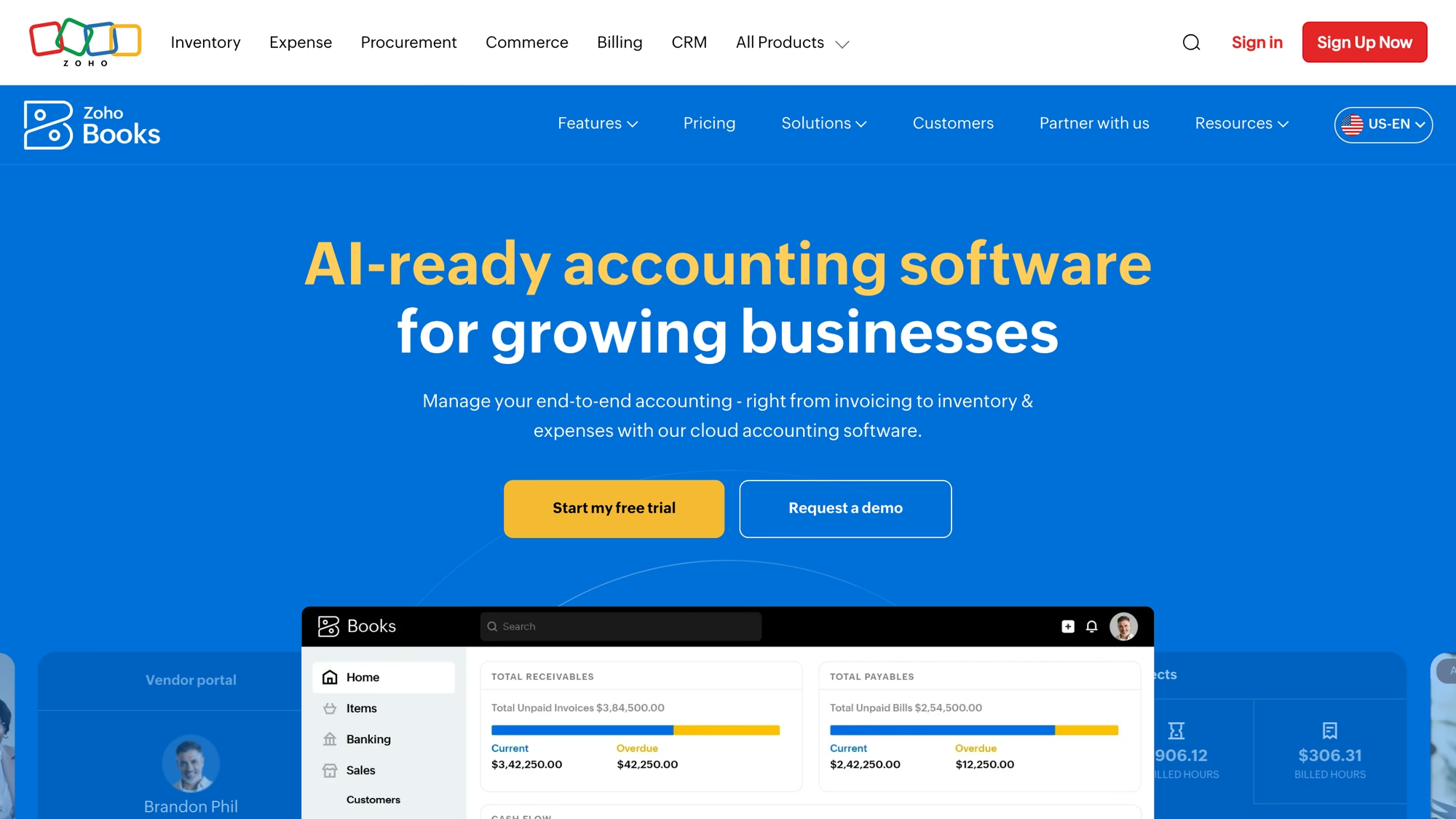
Bank feeds start on Standard, which is $15 a month billed annually or $20 billed monthly and covers 3 users. Professional is $40 or $50 for 5 users, and Premium is $60 or $70 for 10 users, all read on 9 November 2026.
Pros
- The free plan allows up to 1,000 invoices and 1,000 expenses a year
- Standard covers 3 users at $15 a month billed annually
- Basic revenue recognition is listed on Premium, which matters to a software startup that bills in advance
Cons
- The free plan stops being available once revenue for the year passes $50K
- Bank feeds are not on the free plan
- Features a startup wants, such as multi-currency, sit on Professional, which is two steps up the ladder
Skip it if you expect to cross $50K of revenue in the first year and want to stay free, since Standard is the next step.
QuickBooks Online
QuickBooks Online suits a startup whose accountant, bank or investor already works in it. The pricing page lists a Free plan at $0 for 1 user with 2 invoices a month and 1 connected bank, and Simple Start at $38 a month for 1 user, shown at $19 for the first 3 months.
Essentials is $85 for 3 users, Plus is $140 for 5 users and Advanced is $340 for 25, read 9 November 2026. QuickBooks is the safe name for accountants, and the cost of that is a price that rises with each user.
Pros
- A Free plan exists, at $0 for 1 user, and the page also offers a 30-day free trial
- Each paid plan lists seats for accountants, 2 on every plan up to Plus and 3 on Advanced
- Simple Start already lists bill pay with free ACH, and the page carries a long list of AI features
Cons
- The Free plan lists no accountant access, and it is capped at 2 invoices a month and 1 bank
- Moving from 1 to 3 users takes you from $38 to $85 a month
- The promotion makes the first quarter look half the size of the real bill
- Several of the AI features are marked beta or limited capacity, so treat them as extras, not as the reason to buy
Skip it if you have three founders and want a flat bill.
Xero
Xero suits teams that add people often, because the US plans carry no per-user license fees. Simple is $10 a month, Early is $27, Growing is $59 and Established is $97, and the page shows 80% off for the first 3 months, read 9 November 2026.
Growing removes the invoice cap and adds budgeting and a 60-day cash flow forecast, and Established adds multiple currencies and a 180-day forecast. Project time and cost tracking is on it too. Payroll is an optional add-on powered by Gusto, so the base price is accounting only. For the payroll side see our comparison of payroll software for small business.
Pros
- No per-user license fees on any of the four plans
- Domestic ACH bill payments are free on every plan, according to the plan lists
- Growing at $59 lifts the invoice and bill caps and adds a 60-day forecast
Cons
- Simple is capped at 10 invoices and 3 bills, and Early at 20 invoices and 5 bills
- The page adds that transactions started by app partners can count toward the invoice limit
- Auto-reconcile is a feature of Growing and Established, and an optional add-on on Simple and Early
Skip it if you send many invoices from day one, because Early stops at 20 and the next price is more than double.
FreeAgent
FreeAgent suits a freelancer or a small team that wants one flat plan with projects and time tracking in it. The pricing page lists a single plan at $22 a month or $220 a year, with a 30-day free trial and no credit card required for the trial.
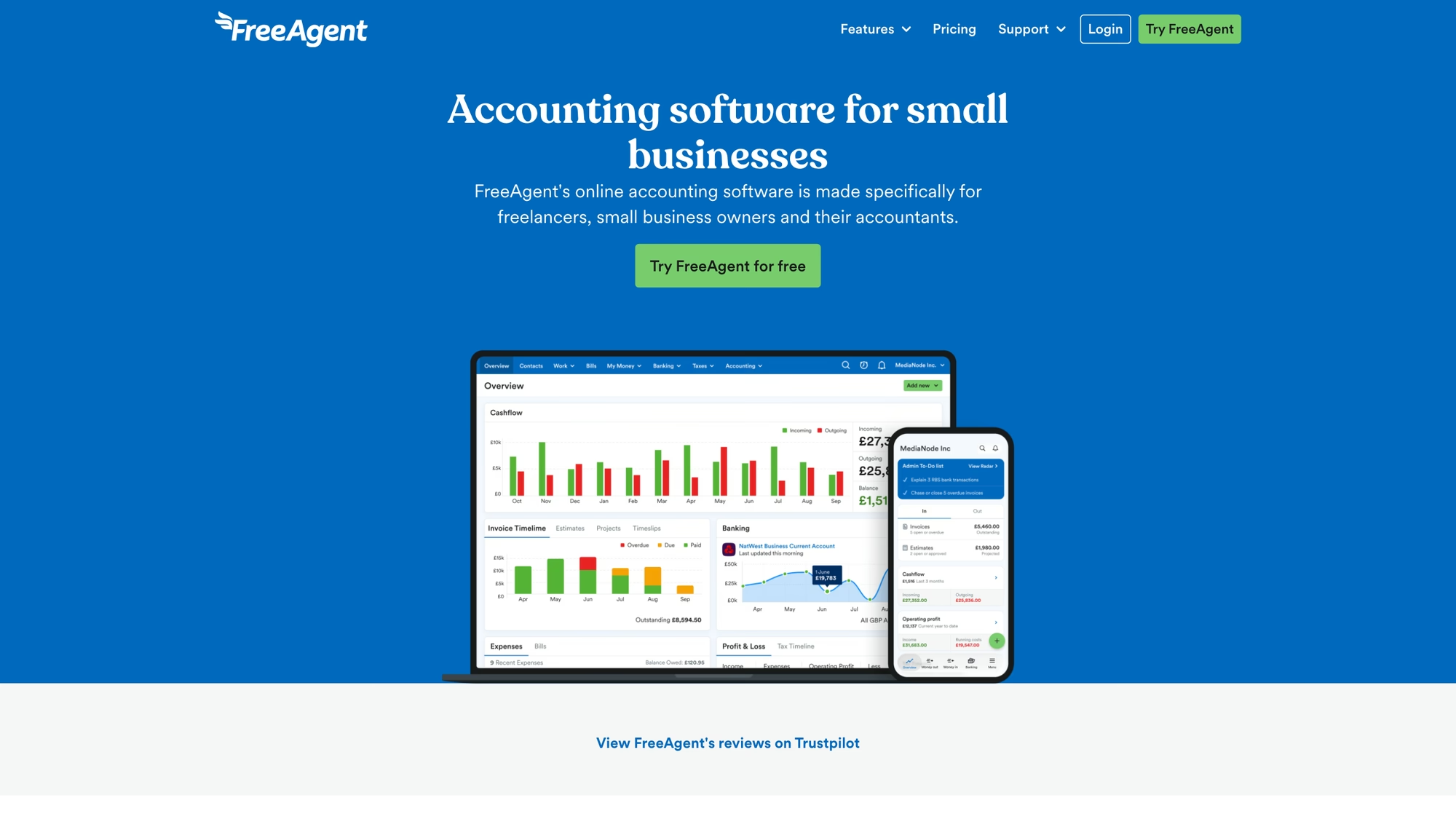
The home page describes the product as made specifically for freelancers and small business owners, and for their accountants. It lists recurring invoices with automatic reminders, bank feeds that import transactions daily, estimates, projects and time tracking. A new-customer offer of 50% off the first six months sits beside the price, read 9 November 2026.
Pros
- One plan at $22 a month, so there is no tier to climb as the company grows
- Sales tax reporting and multi-currency invoicing are named in the plan
- There are no set-up fees, you can cancel from inside the account, and the page says you can download your data at any time
Cons
- There is no free plan, only the 30-day trial
- Unlimited receipt scanning with Smart Capture is an add-on at $6 a month
- The home page and the pricing page speak to freelancers and small businesses and do not mention investor reporting or several entities
Skip it if you want a free plan to start on, or reports built for an investor board.
FreshBooks
FreshBooks suits a startup that sells services and thinks in clients and invoices. Lite is $23 a month for 5 billable clients, Plus is $43 for 50 and Premium is $70 for unlimited clients, read 9 November 2026, with an 80% promotion for the first 4 months shown beside them.
Accounting reports and receipt scanning begin on Plus, not Lite, and so does accountant access. The client count is the limit to watch: a startup billing 60 customers cannot use Plus, and Premium is three times the price of Lite.
Pros
- Lite is $23 a month, the lowest price of the client-based plans
- The home page says free onboarding is included
- The page says deleting old clients frees spots under the cap
Cons
- Extra team members cost $11 a month each
- Accountant access, accounting reports and receipt scanning are on Plus, which is $43
- Advanced Payments is an add-on at $20 a month, and FreshBooks Payroll is $40 a month plus $6 per user
Skip it if you sell a product to many customers instead of billing a few clients, since a plan sized in clients was not designed for that.
Kashoo
Kashoo suits a small team that wants one plan with every feature and every user included. The pricing page lists a single plan at $30 a month or $324 a year, with a free 14-day trial and no credit card needed.
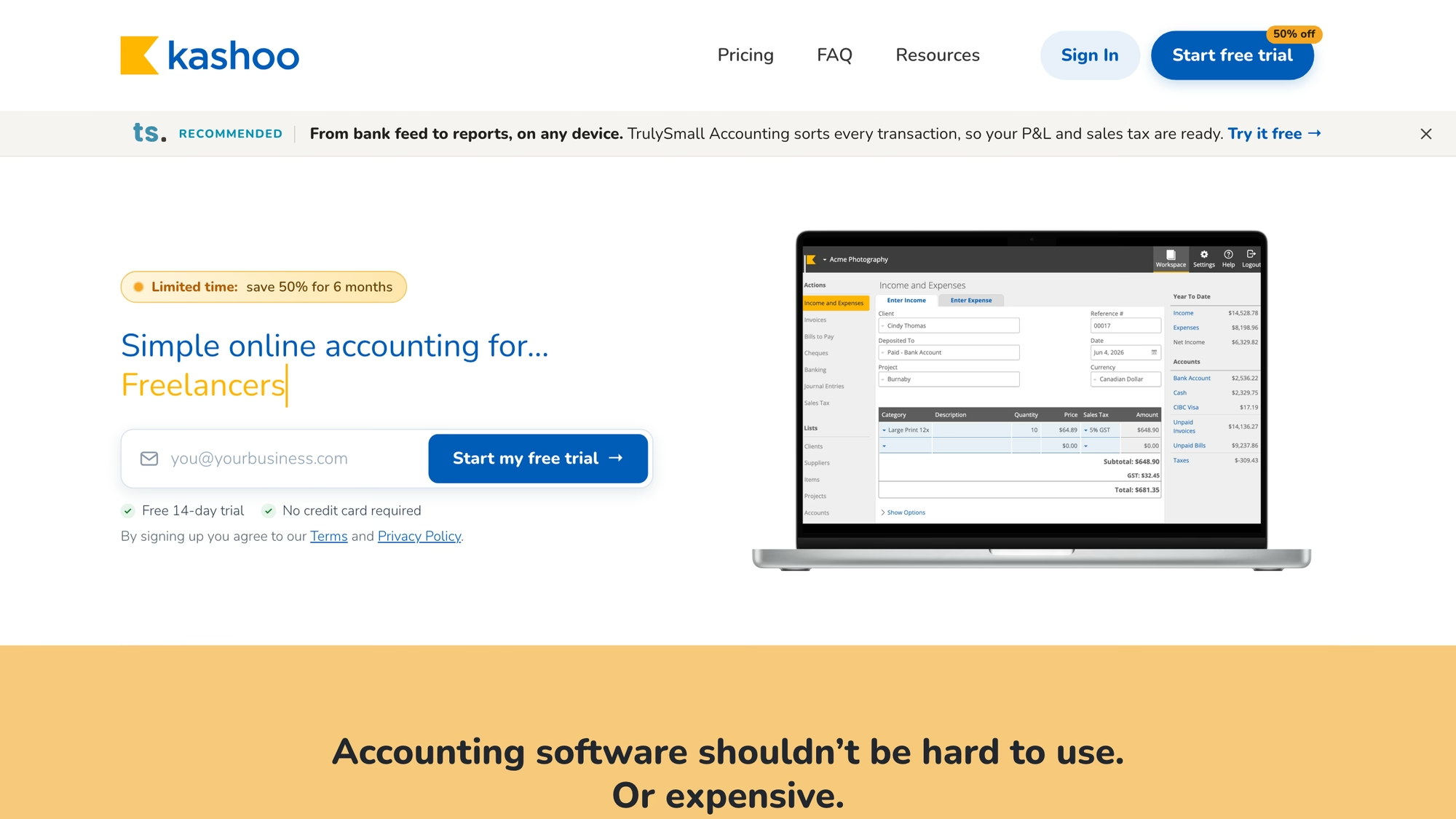
The plan lists unlimited invoices, online payments, bills, sales tax, projects, inventory items, multi-currency and unlimited attachments, with a Square integration and a payroll integration with PaymentEvolution. At the end of the trial the account is kept for another 90 days. A 50% offer for the first 6 months was shown on 9 November 2026 and is not counted in the price.
Pros
- Unlimited users at no extra charge, with access levels you can assign
- Bank feeds through Plaid, plus CSV and OFX imports and Stripe and Square connections
- One plan with sales tax, projects and multi-currency inside, so there is nothing to upgrade to
Cons
- There is no free plan, only the 14-day trial
- Each additional business needs its own subscription, and more than 5 businesses need a quote
- Payroll is an integration, and the page puts auto-posting and receipt scanning under a separate Kashoo product
Skip it if you run more than one company, or want AI categorisation inside the plan.
Puzzle
Puzzle suits a founder who wants AI to draft the books and a finance view of cash and runway. The Puzzle pricing page lists Starter at $30 a month for 1 seat, Core at $72 for 5 seats, Complete at $120 with unlimited seats and Scale at $360, and says yearly billing is 12 months for the price of 10, all read on 9 November 2026.
Starter says 85 to 90 percent of transactions are categorised automatically, which is the vendor’s claim and not ours. Core adds insights on cash and runway, and on margin, a custom chart of accounts, and help moving from QuickBooks.
Pros
- Core adds cash and runway insights, margin insights and help moving from QuickBooks
- Complete lists integrations with Stripe and Ramp, plus Mercury and Brex, and revenue recognition
- Yearly billing is 12 months for the price of 10
Cons
- AI credits are metered: Starter and Core list 25 lifetime credits and Complete 100 a month
- Seats are fixed by plan, 1 on Starter and 5 on Core
- The categorisation figure is the vendor’s own, and the page does not say what it was measured on
Skip it if your accountant works only in QuickBooks or Xero, since a ledger they will not open costs you their time. Ask which tool they use before you pick.
Digits
Digits suits early-stage companies that want AI bookkeeping and an investor-ready ledger from the first month. Essentials is $65 a month for what the vendor calls solopreneurs and early-stage businesses, Core is $100 for small businesses and growing companies, and Pro at $250 is marked coming soon, read 9 November 2026.
Every plan lists AI bookkeeping and reconciliation, bank and payroll connections to more than 12,000 institutions, and a developer API. It has no free plan, and $65 is the highest entry price of the nine software products, against $38 at QuickBooks Simple Start.
Pros
- All plans include AI bookkeeping and reconciliation, bank and payroll connections and a developer API
- All plans support several entities, free for the first 250 transactions a year per additional entity
- The page describes Essentials as made for solopreneurs and early-stage businesses
Cons
- No free plan, and the entry price is $65 a month
- Additional entities cost from $35 a month once they pass 250 transactions a year
- The Pro plan at $250 is marked coming soon, so the top tier cannot be bought yet
Skip it if you are a freelancer with a handful of invoices, since Wave or the Zoho Books free plan cover that for nothing.
Pilot
Pilot suits a founder who wants a team to keep the books, not software to run them. The pricing page lists Essentials at $99 a month for books covering up to $100,000 in monthly expenses, where AI categorises transactions, reconciles accounts and closes the books monthly.
Core starts at $299 a month billed annually and adds a US-based bookkeeper and accrual-basis books, with a custom chart of accounts. Pilot calls itself 50/50 people and software, so this is a service with software included, not one of the self-serve products above.
Pros
- Essentials includes a year-end package for your tax preparer, and instant AI answers about past transactions and cash flow
- Core adds a US-based bookkeeper who handles, explains and reviews the books, with reports on the 10th business day
- The page offers a discount on Core to pre-revenue startups, on request
Cons
- Essentials is cash-basis with a standard chart of accounts, and support is in-app messaging only
- Tax filing is priced apart, from $1,000 a year for a single-member LLC to $2,450 for a C-corp, and must be bought with Pilot Bookkeeping
- Core and Custom list no fixed price beyond a starting figure, and every plan button says Contact Sales
Skip it if you want to keep your own ledger and do the books yourself, since Pilot sells the work, or if the budget is under $99 a month.
What accounting software costs a startup over a year
Most of these tools price per company, not per seat, so the useful number is the year, not the month. The table shows 12 months of list price for the entry plan of each paid product, plus the plans that cover three users or more. Figures are before tax and before any add-on.
| Product and plan | Monthly price | Year at list price | Users in the plan |
|---|---|---|---|
| Xero Simple | $10 | $120 | No per-user fee |
| Wave Pro | $19 | $228 | Not stated |
| Zoho Books Standard | $20 monthly, $15 annual | $240 or $180 | 3 |
| FreeAgent | $22 | $264 or $220 | Not stated |
| FreshBooks Lite | $23 | $276 | 1, plus $11 per added member |
| Xero Early | $27 | $324 | No per-user fee |
| Kashoo | $30 | $360 or $324 | Unlimited |
| Puzzle Starter | $30 | $360 | 1 |
| QuickBooks Simple Start | $38 | $456 | 1 |
| Digits Essentials | $65 | $780 | Not stated |
| Puzzle Core | $72 | $864 | 5 |
| QuickBooks Essentials | $85 | $1,020 | 3 |
| Pilot Essentials | $99 | $1,188 | Not stated |
Every year figure is the monthly price multiplied by 12, read on 9 November 2026. Where a vendor lists a yearly price, it is the second figure. Puzzle also bills 12 months for the price of 10 on a yearly plan.
Three users cost $1,020 a year on QuickBooks Essentials and $180 a year on Zoho Books Standard billed annually, read 9 November 2026. The price on the first line of a comparison is rarely the price of the plan a team of three ends up on.
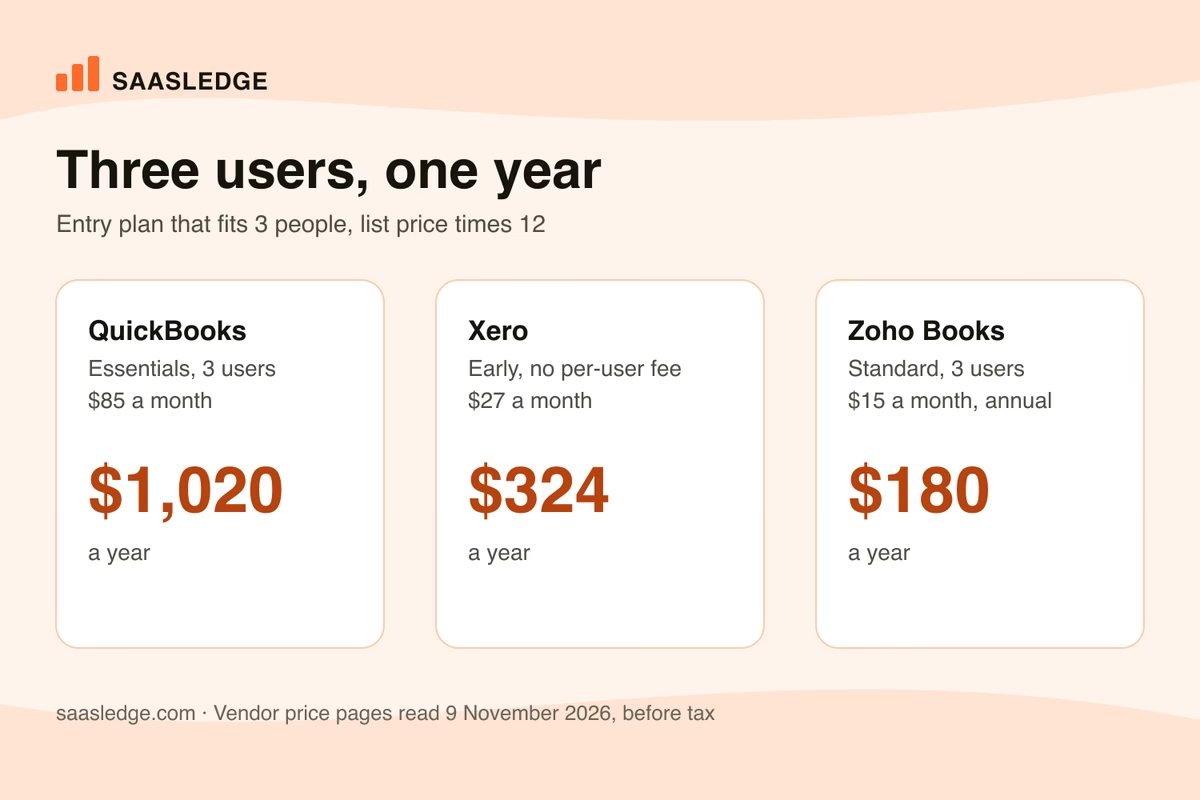
The diagram shows the three plans that cover a three-person team without a custom quote. Xero is the middle case: its price does not move with users, but the 20-invoice cap on Early does.
Free accounting software for startups: what free allows
Free accounting software for startups is a real option for one person and a trial for everyone else. Zoho Books lists a free plan for 1 user and 1 accountant under $50K of revenue, Wave Starter is $0 with unlimited invoices, and QuickBooks Free allows 2 invoices a month and 1 bank.
Free plans have three ceilings. Users come first: Zoho Books and QuickBooks each list one user, and Wave keeps extra roles for Pro. Bank feeds come second. Wave puts them on Pro and Zoho puts them on Standard. Reporting and approval workflows come third.
The best startup accounting software for a first year is therefore often a free plan, and the real question is when the first paid step arrives. Pick the free plan whose first paid plan you can afford, not the one with the longest free feature list.
AI accounting software for startups: what to check
AI accounting software for startups is a category on its own now. Puzzle and Digits are the two here that build the product around it, with Pilot adding AI to a service. QuickBooks lists many AI features too, mostly marked beta, as add-ons to a conventional ledger.
Three checks separate a real feature from a label. Ask what it does to a transaction, such as categorise, match or reconcile. Ask who reviews the result, since a ledger an investor will read cannot be left to an unchecked model. Ask how it is metered, because Puzzle lists AI credits and the Digits pricing page lists none.
The vendor’s number is not yours. A claim such as 85 to 90 percent of transactions categorised automatically depends on how clean your bank feed and vendor names are, so test it on one month of your own data before trusting it.
Early stage SaaS startup accounting software
An early stage SaaS startup bills in advance, often in several currencies, and sells through Stripe. That raises three needs. Revenue recognition comes first, then multi-currency, then a link to the payment processor.
Zoho Books lists multi-currency on Professional and basic revenue recognition on Premium. Xero lists multiple currencies from Established at $97. Puzzle lists revenue recognition and Stripe on Complete at $120. Kashoo lists multi-currency in its single plan. Each of the others is a plan above the entry price.
A SaaS startup should price the plan with those features, not the entry plan. The payments shelf lists the processors those integrations connect to, and the CRM shelf matters once sales starts, as the guide to the best CRM for small business explains.
Limits that decide fit
Five limits decide the real cost of startup accounting software, and none is in the headline price. Each one can be read on the vendor’s page before you sign.
Invoice and bill caps. Xero Simple stops at 10 invoices and 3 bills and Early at 20 and 5, while the Zoho Books free plan stops at 1,000 invoices a year. A product business that invoices through its checkout rarely hits these, a service business can.
Client caps. FreshBooks counts active and archived clients, 5 on Lite and 50 on Plus. Deleting old clients frees spots, according to the page.
Seat prices. QuickBooks and FreshBooks charge more as users are added. Xero and Kashoo do not. Puzzle fixes the number of seats by plan.
Credits and promotions. Puzzle meters AI credits. QuickBooks, Xero, FreshBooks, Wave, FreeAgent and Kashoo all show a time-limited discount near the price, and a number copied into a spreadsheet is valid for the day it was read. We wrote up the pattern behind such gaps with the questions that pull the missing numbers out of a sales call.
Payroll and invoicing as extras. Xero Payroll is a Gusto add-on and FreshBooks Payroll is $40 a month plus $6 per user. The payroll and invoicing shelves list the standalone options.
Software, bookkeeper or both
Software does the ledger, and a bookkeeper does the judgment. A startup that does not want to touch the books has three paid routes on the pages read for this article.
Wave Advisors starts at $149 a month and includes a dedicated bookkeeper and monthly statements. Pilot Essentials is $99 a month for books covering up to $100,000 in monthly expenses. Puzzle sells Core plus Expert Reviewed bookkeeping at $171 a month for up to $10K in monthly expenses, with eligibility rules: one entity, no payroll, no inventory.
These are services with software included, not substitutes for the self-serve products above. For a founder with a few transactions a week, the free plans cost less, and a part-time accountant at year end may be enough.
How to trial and move in without losing a month
A best accounting software for startups 2025 list is already out of date on price, which is why every figure here carries its reading date. Run the trial on your own transactions, not sample data, and give it one full month if the trial length allows it.
Moving into accounting software takes a weekend when the data is clean, and the work is not the import. It is deciding the chart of accounts and reconnecting every bank and payment feed.
- Export the last 12 months of transactions from your bank and card accounts and the invoices you have sent.
- Pick a chart of accounts with your accountant before you import anything, and keep it short.
- Connect the bank feeds on day one, since a ledger with manual entry becomes a task people skip.
- Reconcile one full month before you trust the reports, and compare the closing balance with the bank statement.
- Give your accountant access and ask what format they want for year end.
During the trial, multiply the plan price by 12 and add the second and third user. Compare your invoice or client count with the plan’s cap. Two questions belong on any vendor call: whether the price on the page is the price on the invoice, and what the next tier costs, because a team that likes the product will be on it within a year.
Last, read the export terms. A tool that exports transactions but not attachments or history keeps the most valuable part of your data when you leave. For a wider shortlist, the browse view filters the catalogue by category and pricing model, with a free-plan switch.
Compare
| Product | Free plan | Entry paid price | Built for |
|---|---|---|---|
| Wave | Yes, Starter | $19 a month, or $190 a year | One founder who invoices clients |
| Zoho Books | Yes, 1 user, under $50K revenue | $15 a month annual, $20 monthly | Small teams that want bank feeds cheaply |
| QuickBooks Online | Yes, 1 user, 2 invoices a month | $38 a month, 1 user | Startups whose accountant already uses it |
| Xero | No | $10 a month, 10 invoices | Teams that add people often |
| FreeAgent | No, 30-day trial | $22 a month | Freelancers and small teams who want one plan |
| FreshBooks | No, trial | $23 a month, 5 clients | Service businesses that bill clients |
| Kashoo | No, 14-day trial | $30 a month, unlimited users | Small teams that want every user included |
| Puzzle | No, 14-day trial | $30 a month, 1 seat | Founders who want AI-drafted books |
| Digits | No | $65 a month | Early-stage companies with investor reporting |
| Pilot | No | $99 a month, books done for you | Founders who want a team to keep the books |
FAQ
What is the best accounting software for startups?
The one whose price at next year’s headcount still fits and whose invoice or client cap is above your volume. For a free start, Zoho Books under $50K of revenue. For a flat bill across users, Xero from $10 a month or Kashoo at $30 with unlimited users. For accountants who insist on one name, QuickBooks Online from $38. All prices were read on 9 November 2026.
Is there free accounting software for startups?
Yes. Zoho Books has a free plan for 1 user and 1 accountant while revenue stays under $50K, Wave Starter is $0 with unlimited invoices, and QuickBooks has a Free plan with 2 invoices a month and 1 connected bank. Zoho Books and QuickBooks list one user each, and Wave keeps extra roles for Pro, so the cost starts at the second seat.
What does accounting software cost a startup?
Entry plans priced in dollars here run from $10 to $99 a month for one company, so $120 to $1,188 a year at list price. Three users on QuickBooks Essentials cost $1,020 a year, and on Zoho Books Standard billed annually $180. Add-ons such as payroll raise the invoice.
Which accounting software do startups prefer?
This article has no neutral count of startups by product, so it does not claim a winner. The tools aimed at startups by their own pages are Digits for early-stage businesses, Puzzle for AI-drafted books, Pilot for startups and small businesses, and Zoho Books, which has a page for startups. The safe approach is to ask your accountant which tool they work in.
What is the best accounting software for startups with several founders?
A plan whose price does not climb per user. Xero has no per-user license fees in the US, Kashoo includes unlimited users in its $30 plan, and Zoho Books Standard covers 3 users at $15 a month billed annually. QuickBooks Essentials covers 3 users at $85 a month, so it is the dearest of the four for a three-founder team.
What is the best accounting software for tech startups and SaaS companies?
Pick for revenue recognition and multi-currency, then check the Stripe link. Puzzle Complete at $120 lists revenue recognition and a Stripe integration, Zoho Books Premium lists basic revenue recognition at $60 a month annual, and Xero Established at $97 lists multiple currencies. Price the plan with those features, not the entry plan.
What is the best easy-to-use accounting software for startups?
Ease is subjective and the pages do not rate it. The tools with the smallest setup are the free plans with few features. Wave Starter and the Zoho Books free plan fit that, while Puzzle and Digits automate categorisation. Trial two on one month of your own data and see which one needs fewer corrections.
Is AI accounting software for startups reliable?
It is reliable for routine categorising and matching, and only as good as the review behind it. Puzzle claims 85 to 90 percent automatic categorisation, which is the vendor’s figure. A ledger an investor will read still needs a person or an accountant to check the close.
Do I need a bookkeeper if I use accounting software?
Not always. Software handles the ledger, and a bookkeeper handles judgment and year-end preparation. Wave Advisors starts at $149 a month, Pilot Essentials is $99 and Puzzle Core with Expert Reviewed bookkeeping is $171. For a handful of transactions a week, a free plan with a year-end accountant may be enough.
Can I switch accounting software later without losing data?
Yes, if the old tool exports transactions and attachments. Check that before signing, because some plans export only a summary. Plan a weekend for a small company with clean data: the import is quick, and the work is the chart of accounts and reconnecting every bank feed.
Read next

Best CRM for small business in 2026
Best CRM for small business in 2026: nine tools with prices read on 26 October 2026, free plans, costs for 3, 10 and 25 users and who should skip each.

Best payroll software for small business in 2026
Best payroll software for small business in 2026: eight products, list prices read on 26 October 2026, costs for 5, 10 and 25 employees and free options.

CRM software examples that actually ship
CRM software examples that are sold today, grouped by what each product was built around, with dated prices, free tier limits, industry versions and a cost table for three team sizes.